
Removing an internal wall to create an open-plan kitchen, enlarge a living area or alter a bedroom layout can be one of the most disruptive parts of a refurbishment project. Even when the wall itself is brick or blockwork, the work may disturb ceiling finishes, boards, floor materials, service boxing, pipework and concealed linings around the opening.
In a London property built or refurbished before 2000, asbestos should be considered before contractors cut into or remove older building fabric. The practical question is not simply “does the wall contain asbestos?” but “what materials will the wall-removal work disturb?”
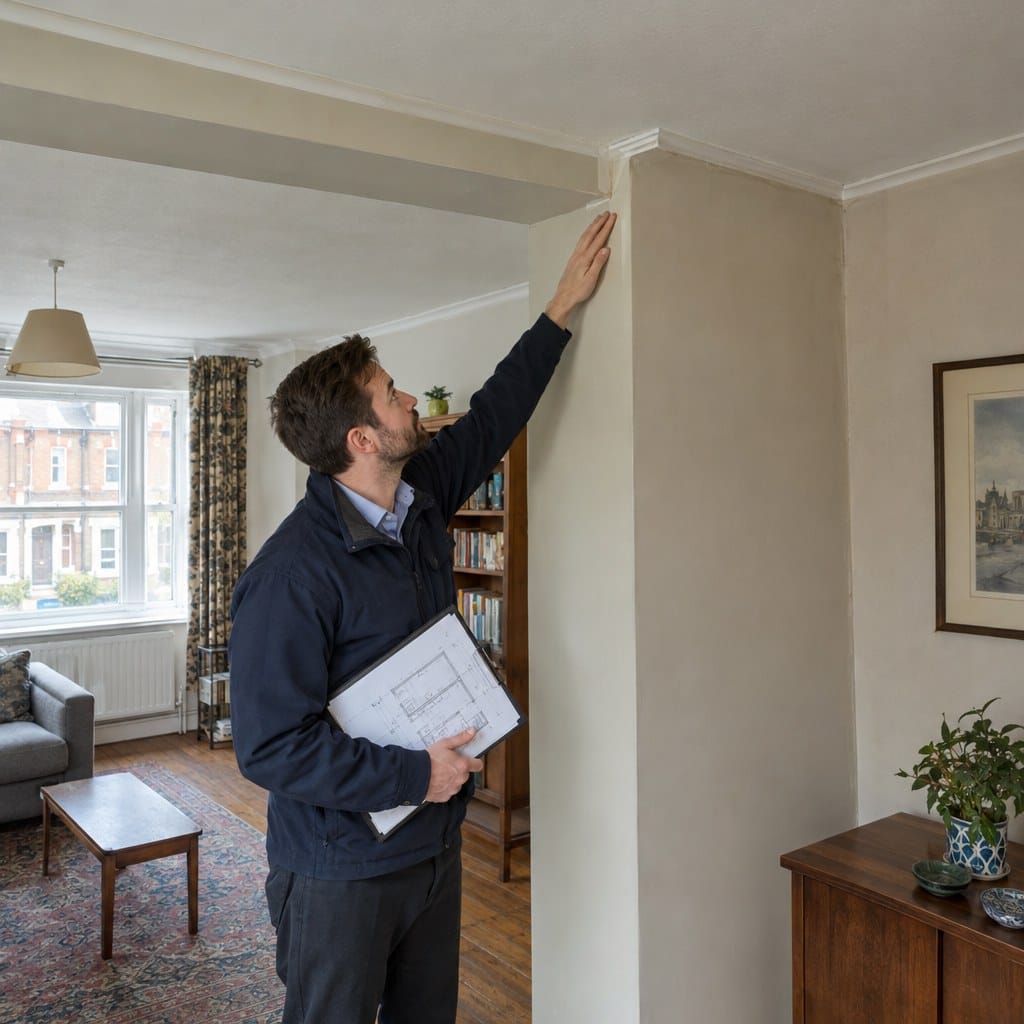
Why knocking through a wall can disturb asbestos
Creating a new opening usually affects more than the wall face. Builders may strip finishes, chase services, remove skirting, open ceilings for a steel beam, expose voids and disturb the floor around the new opening.
HSE’s Asbestos: The survey guide (HSG264) explains that refurbishment surveys are intended to locate asbestos-containing materials in areas where the building fabric will be disturbed. These surveys can require access into concealed locations that a management survey would not normally inspect.
Where asbestos may be encountered around an internal wall
| Area affected by the work | What may need checking |
|---|---|
| Wall or partition lining | Older partitions can include asbestos insulating board (AIB), asbestos cement panels or other historic board products. |
| Textured wall or ceiling coatings | Some older decorative coatings may contain asbestos and can be damaged when walls or ceilings are cut back. |
| Ceiling around a new steel beam | Opening the ceiling may expose old boards, fire-protection materials or concealed service areas. |
| Floor finishes at the opening | Older vinyl tiles, backing materials or bitumen adhesive can be disturbed when the floor is made good. |
| Electrical service routes | Rewiring or rerouting cables may disturb boards, fuse-box backing panels or concealed wall finishes. |
| Pipework and heating services | Older pipe insulation or panels around heating equipment can be affected when services are moved. |
| Door heads and adjoining panels | Fire-resistant boards and infill panels used in earlier alterations may contain asbestos. |
Does every internal wall removal need an asbestos survey?
No. The appropriate level of investigation depends on the age and history of the property, the wall construction, the extent of the work and what asbestos information already exists.
Removing a recent lightweight partition in a modern extension is different from knocking through a wall in a 1960s, 1970s or 1980s property where ceilings, floor finishes, fire-protection boards and service routes may also be disturbed.
Where intrusive work is planned in a building that may contain asbestos, suitable information should be available before work begins. HSE reiterated in 2026 that materials which may contain asbestos should be properly identified before refurbishment, maintenance or repair work through a suitably intrusive survey where necessary.
Brick walls can still involve asbestos risk
A common misunderstanding is that a brick or block wall means asbestos is not relevant. The masonry itself may not contain asbestos, but wall removal often affects the materials fixed to it or passing through it.
For example, plasterboard or AIB linings may sit against the wall, textured coatings may cover the wall and ceiling, old vinyl flooring may run underneath a partition, and electrical or heating services may need to be rerouted before a structural opening is formed.
The survey scope should therefore follow the whole work package, not just the wall material.
Load-bearing walls and steel beam installation
Removing a load-bearing wall usually requires temporary support and a structural beam. This can extend the disturbance into the ceiling void, adjoining walls and sometimes the floor above.
Areas that may need investigation include:
- ceiling finishes where the beam will be inserted;
- wall heads and bearing points;
- boxed-in services or pipework beside the opening;
- older fire-protection boards around structural elements;
- floor finishes that will be cut back or replaced;
- adjacent rooms where services are rerouted.
If a structural engineer has already produced drawings, these are useful for defining the asbestos survey area.
Management survey or refurbishment survey?
A management survey is mainly intended to support normal occupation and routine maintenance. It is generally less intrusive and may not inspect inside walls, above fixed ceilings or behind other finishes that will only become accessible during refurbishment.
HSG264 distinguishes refurbishment surveys because their purpose is to identify asbestos-containing materials within the area of planned works before the fabric is disturbed.
For an internal wall removal project, the survey can often be targeted to the wall, ceiling, floor and service zones affected by the knock-through rather than unrelated areas of the property.
HSE examples of asbestos locations in homes
HSE’s asbestos building diagrams show a range of possible locations in residential property, including AIB partition walls, ceiling tiles, panels around windows and fires, textured coatings, vinyl floor tiles and boards around electrical or heating equipment.
The diagrams are useful for understanding why a wall-removal job can disturb more than one type of material, but they do not replace a property-specific survey or sampling assessment.
Owner-occupied homes, landlords and contractors
The specific duty to manage asbestos under Regulation 4 of the Control of Asbestos Regulations 2012 applies to non-domestic premises and relevant common parts; it does not automatically make every private homeowner a dutyholder.
However, employers and contractors still have legal responsibilities to assess asbestos risk and prevent exposure before work that could disturb asbestos-containing materials. Landlords, freeholders and managing agents may also have additional responsibilities where they control maintenance or repair of common or non-domestic areas.
For homeowners, the practical priority is to make sure the builder or contractor has suitable information about suspect materials before demolition, drilling or cutting begins.
Internal wall removal asbestos checklist
- Was the property built or substantially refurbished before 2000?
- Is the wall original, or is its construction history uncertain?
- Will textured coatings on walls or ceilings be disturbed?
- Will the ceiling be opened to install a steel beam?
- Will old floor tiles, backing or adhesive be cut back?
- Will electrical, heating or plumbing services be rerouted?
- Are there boards, panels or boxing around the wall or services?
- Does an existing asbestos survey cover the exact wall, ceiling and floor zones?
- Were any relevant voids or concealed areas previously recorded as “no access”?
What should you give the asbestos surveyor?
A clear work scope makes the survey more useful. Where available, provide:
- structural engineer or architect drawings;
- the exact wall or opening to be removed;
- the proposed beam position and bearing points;
- areas where ceilings will be opened;
- flooring that will be removed or made good;
- planned electrical, plumbing or heating alterations;
- previous asbestos reports or sampling results.
This helps the surveyor inspect the areas that will actually be disturbed and reduces the risk of important exclusions.
What if suspected asbestos is uncovered after work starts?
If an unexpected material that may contain asbestos is uncovered, work in the affected area should stop and the material should be left undisturbed until it has been assessed.
The correct response depends on the material, its condition and the work required. Some lower-risk asbestos work can be undertaken by appropriately trained workers using suitable controls, while higher-risk work requires an HSE-licensed contractor.
Finding asbestos does not automatically mean every asbestos-containing material in the property must be removed. The immediate issue is whether the material will be disturbed by the wall-removal project and how the risk should be controlled.
Related London refurbishment guidance
If the wall removal forms part of a larger renovation, see our guide to asbestos surveys before renovating a London home. For rear or side-return projects, our house extension asbestos guide covers the junction between old and new construction. If the ceiling has a textured finish, read our guide to Artex and textured ceilings.
Need an asbestos survey before removing an internal wall in London?
If you are planning a knock-through, open-plan conversion or load-bearing wall removal in a London property, we can help define an asbestos survey or sampling scope around the parts of the existing building that will be disturbed.
Request an asbestos survey quote and include the property type, approximate age and any structural drawings or description of the proposed opening.
This article provides general information and does not replace a property-specific asbestos assessment or professional advice.