
Older garages, sheds and outbuildings in London sometimes have corrugated cement roof sheets that may contain asbestos. The material cannot be confirmed reliably by appearance alone, so repair, replacement or removal should be planned around reliable asbestos information before the roof is drilled, cut, broken or otherwise disturbed.
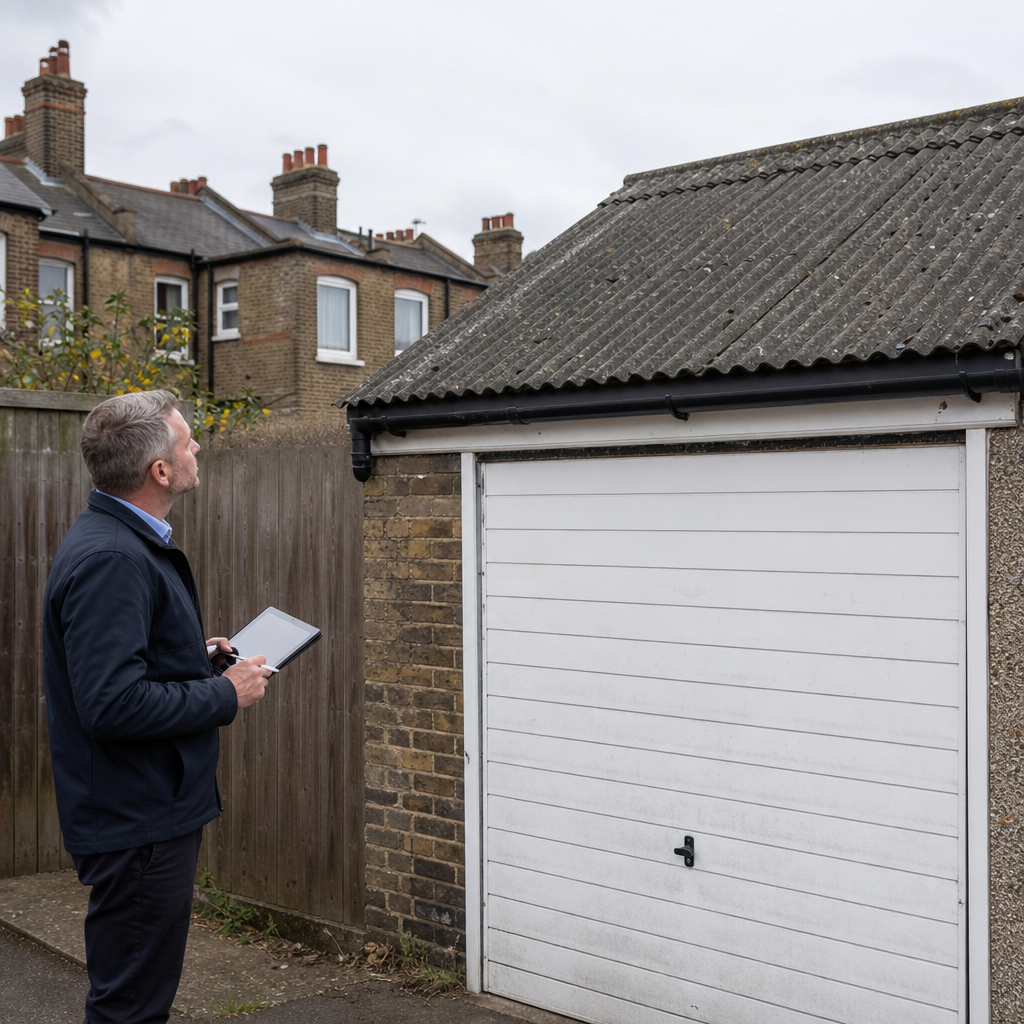
Where asbestos cement may be found
Asbestos cement was used in a range of external building products, including corrugated roof sheets, wall cladding, gutters, downpipes and some small outbuilding components. A garage or shed roof that looks like fibre-cement sheeting is not automatically asbestos-containing, but its age, product history and condition can indicate that further checking is sensible before work starts.
Why the condition of the roof matters
Intact asbestos cement generally presents a lower fibre-release risk than many higher-risk asbestos materials when it is left undisturbed and managed appropriately. The risk changes when material is badly weathered, damaged, drilled, sawn, smashed or removed without suitable controls.
There is also a separate fall risk: the Health and Safety Executive (HSE) warns that asbestos-cement roofs are fragile and should not be treated as weight-bearing surfaces.
Before repairing or replacing a garage roof
- Check the approximate age and construction history of the garage, shed or outbuilding.
- Review any previous asbestos survey, sampling result or asbestos register that covers the structure.
- Do not assume a corrugated cement sheet is asbestos-free because of colour, texture or visual condition.
- Define exactly what the contractor plans to disturb: fixings, sheets, flashings, gutters, cladding or adjacent building fabric.
- If the material is uncertain and the work will disturb it, consider targeted asbestos sampling and laboratory analysis or an appropriately scoped survey before work starts.
- Give relevant asbestos information to the contractor carrying out the work.
Do you need an asbestos survey?
The answer depends on the property and the work. For normal management of non-domestic premises and common parts of domestic premises, the asbestos management survey process can help identify and record accessible asbestos-containing materials. Where refurbishment or demolition work will disturb the building fabric, a more intrusive refurbishment or demolition survey may be required for the area affected by the work.
For a small domestic garage or shed, targeted sampling may sometimes answer a narrow question about a specific roof sheet. For a broader project, or where several materials or inaccessible areas are involved, the survey scope should be agreed before work begins.
Can asbestos-cement sheets be removed without a licensed contractor?
Not all work involving asbestos cement is licensed asbestos work. HSE guidance includes some small-scale asbestos-cement tasks within its non-licensed asbestos essentials guidance, but that does not mean every roof can be treated as a simple DIY removal job. The material type and condition, scale of work, likelihood of breakage, worker competence, risk assessment, waste handling and other site hazards all matter.
HSE’s asbestos essentials guidance for asbestos-cement sheets states that small structures such as garages and sheds can fall within non-licensed guidance when the asbestos cement remains intact during removal; if it starts to break up and generate significant dust, the work can become notifiable non-licensed work. See HSE Asbestos Essentials task sheet A14.
Do not overlook roof-access hazards
Asbestos is only one of the risks. Corrugated asbestos-cement roofing is fragile, and working at height requires its own planning and controls. Property owners should avoid sending contractors onto a suspect fragile roof until both asbestos and safe-access issues have been considered.
What if the garage is part of a commercial or communal property?
The legal duty to manage asbestos under Regulation 4 of the Control of Asbestos Regulations 2012 applies to non-domestic premises and can also apply to common parts of domestic premises. Dutyholders should maintain suitable asbestos information, manage identified risks and make relevant information available to people who may disturb asbestos during maintenance or building work. HSE’s current guidance explains the duty to manage asbestos.
Planning garage or shed roof work in London?
If you are unsure whether a garage, shed or outbuilding roof contains asbestos, the safest next step is to define the proposed work and obtain suitable asbestos information before disturbing the material.