
Cavity-wall insulation is usually installed by drilling a pattern of small holes through the external wall and injecting insulation into the cavity. In many London homes this is straightforward, but in older buildings the wall cavity and the materials around it may contain asbestos that has never been visible from inside or outside the property. For an occupied building, a management survey can support ongoing asbestos records; the proposed drilling areas need to be assessed separately before work.
The key issue is not that modern cavity-wall insulation contains asbestos. It is whether drilling into a pre-2000 wall could disturb older asbestos-containing materials, including concealed boards, cement products, textured finishes or, in rare cases, loose-fill asbestos within a cavity.
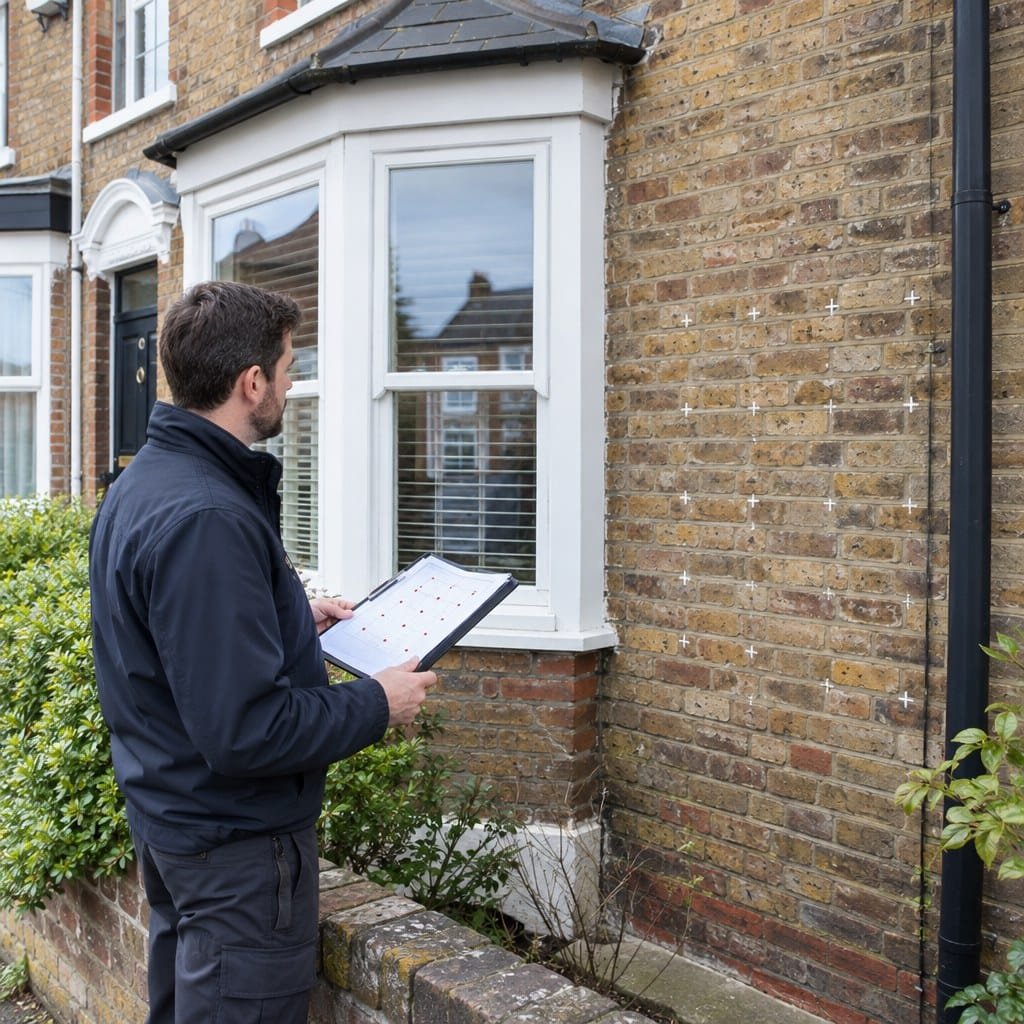
Why cavity-wall insulation can raise an asbestos question
HSE’s guidance on where asbestos may be found specifically notes that loose asbestos insulation can occur in wall cavities, under floorboards and in loft spaces. HSE also illustrates the risk of loose-fill asbestos being disturbed when a wall cavity is drilled.
Loose-fill asbestos is particularly hazardous because the fibres are not bound into a solid product. It should not be disturbed except by an appropriately licensed contractor.
That does not mean every cavity wall in an older London home contains asbestos. Most do not. The practical point is that an installer should not assume a concealed cavity is asbestos-free simply because nothing suspicious is visible on the surface.
What cavity-wall insulation work may disturb
| Part of the installation | Possible asbestos-related issue |
|---|---|
| Drilling through external wall finishes | Older cement panels, textured coatings or other surface materials may be disturbed before the drill reaches the masonry. |
| Drilling through cavity construction | Concealed materials inside the cavity may not have been visible during a previous non-intrusive survey. |
| Working around soffits or roofline junctions | Asbestos cement or AIB soffits and fascia materials are common asbestos locations in older buildings. |
| Accessing service routes | Pipe, cable or duct penetrations may include historic asbestos-containing sleeves, fire stops or boards. |
| Making good around internal finishes | Textured coatings, older wall boards or decorative finishes may be affected depending on the installation method. |
Does every cavity-wall insulation project need an asbestos survey?
No. The need for investigation depends on the age and construction of the building, what materials are present, the drilling locations and what reliable asbestos information is already available.
A modern post-2000 house is different from a 1960s or 1970s property with unknown refurbishment history, older soffits, unusual wall panels or previous reports that recorded inaccessible wall cavities.
HSE’s 2026 guidance continues to stress that materials which may contain asbestos should be properly identified before refurbishment, maintenance or repair work begins where the work could disturb them. A suitably intrusive refurbishment survey may be appropriate when hidden building fabric will be affected.
Management survey or targeted refurbishment survey?
A management survey is mainly intended to support normal occupation and routine maintenance. It is generally less intrusive and will not necessarily confirm what is inside a sealed cavity wall.
HSE’s Asbestos: The survey guide (HSG264) explains that refurbishment surveys are designed to locate asbestos-containing materials in areas where building fabric will be disturbed. For limited work, the survey can be targeted to the specific area of the project rather than covering unrelated parts of the property.
For cavity-wall insulation, that may mean focusing on the proposed drilling elevations, wall construction, soffit or fascia junctions, service penetrations and any areas that previous reports could not access.
Loose-fill asbestos in wall cavities
Loose-fill asbestos is one of the highest-risk asbestos materials because it can release fibres very easily when disturbed. HSE describes it as a loose, fluffy insulation material and notes that it can occur in cavity walls.
If an installer encounters an unexpected loose fibrous material while drilling or opening a wall, work should stop immediately. The material should not be sampled, vacuumed, brushed or otherwise disturbed by an untrained person.
Identification by appearance alone is not reliable. A competent asbestos professional may need to assess the material and determine the appropriate next step.
What about asbestos cement, soffits and external panels?
Drilling positions near eaves, extensions, external panels or roofline details can affect materials other than the cavity itself. HSE’s residential asbestos diagrams show asbestos cement or AIB in soffits and fascias, exterior window panels, roofing products and other external building elements.
Asbestos cement is generally lower risk than loose-fill asbestos or sprayed coatings when it remains intact, but drilling or cutting it still requires appropriate controls and competence. The type of work, condition of the material and method used determine whether it is licensed, notifiable non-licensed or non-licensed work.
What should the insulation installer provide?
A useful asbestos assessment starts with a clear installation plan. Ask the insulation contractor for:
- the elevations that will be drilled;
- the approximate drilling pattern and hole diameter;
- whether access is required near soffits, fascias or roof junctions;
- whether internal walls or finishes will also be opened;
- whether vents, ducts, pipes or cables will be altered;
- the construction type of the external walls if known;
- any areas they consider unsuitable or unusual for insulation.
This allows a surveyor to assess the parts of the building that will actually be disturbed instead of commissioning unnecessarily broad investigation.
Owner-occupied homes, landlords and contractors
The specific duty to manage asbestos under Regulation 4 of the Control of Asbestos Regulations 2012 applies to non-domestic premises and relevant common parts; it does not automatically make every private homeowner a dutyholder.
However, employers and contractors still have duties to assess asbestos risk and prevent exposure before work that could disturb asbestos-containing materials. For homeowners, the practical priority is to make sure the installer has suitable information about the building materials before drilling begins.
Landlords, freeholders and managing agents may have additional responsibilities where they control maintenance or repair of common or non-domestic areas.
Cavity-wall insulation asbestos checklist
- Was the property built or substantially refurbished before 2000?
- Are the walls original, or has the building been extended or over-clad?
- Will drilling pass through older external panels, coatings or cement products?
- Are soffits, fascias or roofline materials close to the drilling area?
- Does an existing asbestos survey cover the relevant external walls?
- Were any wall cavities or concealed areas recorded as “no access”?
- Is there any historic information about unusual cavity insulation or fire-stopping materials?
- Has the installer provided a clear drilling plan?
What if suspected asbestos is found after drilling starts?
If an unexpected material that may contain asbestos is discovered, work in the affected area should stop and the material should be left undisturbed until it has been assessed. HSE’s guidance is clear that work should stop if asbestos is suspected.
The correct response depends on the material, its condition and the work required. Some lower-risk asbestos tasks can be carried out by appropriately trained workers using suitable controls, while high-risk materials and activities require an HSE-licensed contractor.
Finding asbestos does not automatically mean all asbestos-containing material in the property must be removed. The immediate question is whether the proposed insulation work will disturb it and how the risk should be controlled.
Related London retrofit guidance
If your insulation project is part of a broader energy upgrade, see our guide to asbestos checks before heat-pump installation in London. For projects involving extensive drilling and new service routes, read our guide to asbestos checks before drilling and cabling. If the work affects the loft, our loft conversion asbestos guide explains other concealed locations that may need consideration.
Need asbestos advice before cavity-wall insulation in London?
If you are planning cavity-wall insulation or another intrusive energy-efficiency retrofit in a London property, we can help define an asbestos survey or sampling scope around the areas that will be drilled or opened.
Request an asbestos survey quote and include the property type, approximate age and the insulation contractor’s proposed drilling elevations or specification if available.
This article provides general information and does not replace a property-specific asbestos assessment or professional advice.